The Heat Death of Your Sci-Fi Universe

What gets called "wokism" in franchise entertainment is actually a structural response to an impossible set of economic constraints. Here's the law that explains why.
A sequel to The Well We Never Tapped
Disclosure: This reflects my personal experience and interpretation of publicly available information. It represents my views alone—not any employer or organization—and is not professional advice.
There used to be time.
Time for a show to find its voice. Time for an audience to discover it. Time for word of mouth to build, unevenly and organically, until something that started small became essential.
That model is gone.
In the streaming era, shows don't grow. They declare.
Within the first few episodes, sometimes within the first weekend, the data is already in. Completion rates. Retention curves. Subscriber impact. The platform knows what it needs to know long before the audience has decided what it thinks.
You don't grow into success anymore. You hit it, or you don't.
The Light That Was
Breaking Bad did not find its audience until season three. By today's metrics, it would not have survived its first. Star Trek: The Next Generation was borderline unwatchable in its first year and took nearly three seasons to become the show people remember. Babylon 5 asked its audience to trust a five-year plan before any of it paid off. The Wire. Arrested Development. Firefly, which never even got its chance.
If you loved any of these shows, you remember what it felt like to discover them — not on premiere night, not because an algorithm surfaced them, but because someone you trusted told you to keep watching. That experience, the slow conversion from curiosity to devotion, is what built the most enduring franchises and the most passionate audiences television has ever produced.
It is also the experience that the current system has made structurally impossible.
And there is another category of loss that goes even deeper. Not shows that needed patience to find their audience, but shows that needed duration to become something larger than entertainment. MASH ran for eleven seasons. Its finale was a national event. Bonanza. Cheers. ER. Law & Order. These were not just hits. They were cultural infrastructure, shows that ran for a decade or more, twenty-two episodes a season, and became part of the background architecture of daily life. The production model that sustained them, advertiser-funded, network-scheduled, built for longevity, will never be rebuilt. The only survivors are The Simpsons, soap operas, and a handful of network procedurals like NCIS that are approaching their final seasons. All grandfathered in. All the last light from a model that stopped producing new entrants years ago. Nothing new will ever join that category again.
Something changed. Not in the audience. In the economics.
The New Math
Modern genre television operates at film-level budgets, tens of millions per season, often approaching or exceeding $100 million. That kind of investment has to move the only metric that matters in streaming: subscribers. Not viewers. Not fans. Subscribers. And not eventually. Immediately.
In the broadcast and cable era, a show with modest but consistent ratings was still valuable. It generated advertising revenue. It filled a schedule. A show didn't have to be the biggest thing on the network. It had to be profitable enough. That "enough" created space for a middle class of television: shows that were not massive hits, not disposable filler, but durable.
Subscription flattened all of that. The question became "does this show move subscriptions?" A completely different question, and one that eliminates the entire category of "profitable enough." Now there are only two viable categories: flagship shows that justify their cost at scale, and everything else.
The shows that once lived in the middle, the critically respected dramas, the genre experiments that found their people over time, those were the creative engine of television for decades. They were where writers learned to be great, where audiences learned to expect more, and where the next generation of franchises was born.
That engine is not stalling. It has been shut off.
The Illusion of the Slow Burn
There are still shows that look like slow-burn success. Silo. Severance. For All Mankind.
But look closer. These are available on Apple TV+, a platform that does not rely solely on streaming for survival. Apple's services revenue dwarfs what Apple TV+ generates on its own. It can afford patience because patience is not existentially expensive. This is not a model. It is a subsidy from a trillion-dollar company that treats prestige content as an ecosystem perk. Nobody else can replicate it because nobody else has a hardware business that makes the losses irrelevant.
Elsewhere, slow burn is often a retrospective illusion. Stranger Things scaled quickly. Fallout and The Last of Us arrived with massive built-in audiences. These are cases of immediate impact dressed in the aesthetics of discovery.
Slow burn still exists. But only where the economics don't require it to be something else.
The System Behind the System
Platforms don't just measure what succeeds. They shape what gets discovered.
A show that the algorithm promotes gets watched. A show that gets watched generates data that justifies more promotion. A show that isn't expected to succeed isn't surfaced, doesn't get watched, and confirms the expectation that it wouldn't. This is a self-fulfilling prophecy dressed up as data-driven decision-making. The algorithm doesn't rescue anything. It optimizes.
This pressure deforms the shows that do get made. Pilot episodes engineered as mini-movies. Mystery-box structures designed to spike first-weekend completion rates. Eight-episode seasons, not because eight is the ideal length for a story, but because eight fits the budget. Within those episodes, there is no room for the quiet detours: a Buffy episode about grief with no music and no monsters ("The Body"), a Sopranos episode where two hitmen get lost in the woods ("Pine Barrens"), a Battlestar Galactica episode that pauses the war to ask whether the fleet's workers deserve a union ("Dirty Hands"). Not gimmicks. Not spectacle. Just stories that let the characters breathe and trusted the audience to stay.
Even Starfleet Academy proved this. Its best episodes were the reflexive, character-driven ones, the Jay-Den episode, the doctor episode, moments where the show stopped performing and got serious. But those accounted for maybe twenty percent of the season. A first season fighting for renewal couldn't afford more. The thing that made the show worth watching was structurally rationed.
The gaps where the best television has always been made have been engineered out.
What remains is efficient. It is also increasingly forgettable. You can feel it when you finish a season and realize you have nothing to say about it. The show was fine. It moved. It ended. You will not think about it again.
All of these points point to a deeper structural problem. But to see it clearly, you have to look at where the industry has concentrated its bets.
Closed Systems
The industry has organized itself around a small number of major franchises: Star Trek, Star Wars, the Marvel Cinematic Universe.
These universes are vast. But they are not infinite. They behave like closed thermodynamic systems.
The more they rely on the same characters, timelines, and canon, the more they limit their ability to evolve. Variation decreases. Narrative space narrows. What once felt expansive begins to feel recursive. At first, familiarity drives engagement. Over time, it produces repetition.
And repetition is the enemy of the only thing streaming actually needs: growth.
Franchises don't expand indefinitely. They circulate. And eventually, they cool.
Binary Orbit
This creates a structural problem.
Stay close to the formula: you retain the core audience, but growth stalls. Move away from the formula: you risk alienating that core and fragmenting the audience. The economics require you to expand beyond the core quickly, so you are pulled in two directions, familiarity and expansion, and required to succeed at both, immediately.
There are exceptions. Andor. The Mandalorian. But these are controlled expansions, not reinventions. They feel new without being unfamiliar. That distinction is everything, and it is extremely difficult to replicate. Andor required a showrunner with a singular vision and a network willing to give him years. That is not a model. That is an exception.
And even the controlled expansions that work creatively are struggling to justify themselves economically. Skeleton Crew did everything right: new characters, Amblin tone, warmth instead of heat. And it posted some of the lowest viewership numbers of any Star Wars Disney+ show. Ahsoka is similar. These shows survive partly because the Volume (the LED virtual production stages that replaced physical sets and location shoots) keeps production costs manageable, but they are not expanding the audience. They are life support, keeping the franchise's pulse going at a price point the system can tolerate, without generating the growth that would justify what comes next.
So the franchise ends up running on two tracks: expensive flagship bets that need to move subscribers and can't, and lower-cost productions that keep the lights on but don't grow anything. Neither track solves the problem. One bleeds money. The other bleeds relevance.
Disney can afford this. It paid $4 billion for Lucasfilm. It has the Volume, the infrastructure, and the content pipeline needs of Disney+. It can sustain multiple concurrent Star Wars productions because even diminishing-return content fills the schedule and keeps subscribers from canceling. Heat death, for Disney, is a slow decline distributed across many shows.
Paramount cannot do any of this. It can sustain maybe two Trek shows at once. Every individual series is existential. Every Starfleet Academy is a bet-the-franchise moment with no cushion of cheaper derivative shows to absorb the risk. Heat death, for Paramount, is a crisis with each production.
Same law. Different scale. Same outcome.
The formula is exhausted. Controlled expansion is a lottery ticket. And the system still demands immediate attention.
What do you do?
Solar Flares
You disrupt.
You take a familiar element of the franchise and invert it. You challenge it. You recontextualize it. Not necessarily because the story earns it, but because the economics demand that people talk about the show right now, and the only tool you have left is surprise.
This is the move that gets labeled "wokism." But the framing is wrong.
The writers know the IP is stale. They know it. They can feel the entropy. They know that another competent, faithful, by-the-numbers entry will land with a thud, respected by the faithful, ignored by everyone else, moving nobody's subscription needle. The safe path leads to slow irrelevance. So they reach for the only lever the system leaves them.
The Acolyte did this within Star Wars. Discovery did it within Star Trek. Starfleet Academy appears to be doing it again. Each one generated enormous discussion. And each one failed to convert that discussion into durable subscriber impact.
This is not isolated to one franchise.
Star Wars is over forty years old. Star Trek is approaching sixty. James Bond is over sixty-five. Marvel's cinematic identity is over thirty. DC's is the same. Every one of these franchises is attempting disruption of its own material, and every one is getting a similar negative reaction when the disruption occurs.
That is not a coincidence. It is a pattern.
These are all the same age class of intellectual property, hitting the same wall at the same time. And the pattern has a direction: the older the franchise, the more intense the backlash.
A five-year-old franchise can absorb disruption because its boundaries haven't hardened yet. A franchise that is fifty years old has spent decades telling its audience what it is. When you contradict that identity, you are not just making a creative choice. You are breaking a contract.
The disruption generates conversation, but the conversation is adversarial. The core feels betrayed. The new audience sees the conflict and stays away.
Star Trek itself demonstrates both sides in real time. When Discovery's disruption alienated the core audience, Paramount read the backlash and spun off Strange New Worlds, a deliberate retreat to the familiar. Episodic structure. Planet-of-the-week. A tone that evokes the Original Series. It worked, at least initially, because familiarity felt like relief after years of disruption.
But the retreat has a direction, and that direction is backward. Strange New Worlds is built on characters whose fates are already known. Pike's destiny is sealed. Spock's future is written. The dramatic ceiling is built into the premise. And the natural successor to Strange New Worlds is a redo of the Original Series itself, the franchise curving back to its starting point and calling it new.
The franchise has already tried that, too. The 2009 film was exactly this move: redo TOS with an alternate timeline as the disruptive twist. It worked initially, because the twist gave the familiar enough energy to feel new. But the Kelvin timeline produced three films, the third underperformed, and the fourth never materialized. Even the redo-with-a-twist ran out of road.
So Star Trek has now demonstrated the entire cycle: disrupt (Discovery), retreat (Strange New Worlds), redo with a twist (the 2009 reboot). All three paths eventually stall. The franchise doesn't just illustrate the law. It is the law, playing out across fifteen years in real time.
There is a principle at work here. It has not, as far as I can tell, been formally stated.
The Law of IP Thermodynamics
In a closed franchise system, two forces move in opposite directions over time.
The first is the energy required to generate novelty. As a franchise ages, its canon calcifies. Its characters become fixed. Its tone becomes established. Its audience develops expectations that harden into identity. Producing something that feels genuinely new requires increasingly forceful disruption: bigger swings, sharper breaks, more radical departures from what came before.
The second is the audience's tolerance for that disruption. The older the franchise, the deeper the audience's sense of ownership. The more time they have spent inside it, the less willing they are to accept fundamental changes to its terms.
These two forces move in opposite directions. The need for disruption increases. The tolerance for disruption decreases.
At some point, the curves cross.
Past that intersection, there is no viable creative move inside the franchise. Repetition produces indifference. Disruption produces rejection. The system reaches equilibrium — heat death — in which no amount of energy input yields meaningful output.
This is not a failure of talent. It is not a failure of execution. It is a structural inevitability of closed systems operating over long timescales.
And it explains why every major franchise currently in crisis is exhibiting the same symptoms simultaneously. They are not failing for different reasons. They are failing for the same reason. They have all crossed the same threshold.
First corollary: The audience's sense of ownership over a franchise grows proportionally with its age, independent of whether any individual viewer has been present for all of it. A twenty-year-old fan of Star Trek feels the weight of sixty years of canon, even if they discovered the show last year. The franchise's accumulated identity is inherited, not earned.
Second corollary: Disruption in a young franchise reads as evolution. The same disruption in a mature franchise reads as a violation. The creative act is identical. The audience response is not.
Third corollary: The only way to escape IP heat death is to exit the closed system entirely. New intellectual property. New canon. New audience contract. You cannot add energy to a system that has reached equilibrium. You can only build a new system.
Franchises have come back from the dead before. But never under economic conditions that penalize patience this severely. The streaming model is not a cycle. It is a geological shift in how content gets funded, measured, and justified. Short of a technological breakthrough that fundamentally resets production economics (AI-generated content that eliminates the cost of human performance and writing, still likely a generation away, and raising the question of whether what it produces would be worth watching at all), these are the conditions. This is the era. And the old recovery playbook, where a franchise goes fallow for a decade and comes back fresh, no longer functions when platforms need content continuously and every quarter demands justification.
The writers are not wrong to try. Within the constraints they've been given, disruption is a rational choice. But it generates heat, not warmth. People talk about the show for a week. They argue. And then they move on, because the conversation was never about the show. It was about the argument. Heat dissipates. Warmth sustains.
All three strategies, repetition, controlled expansion, and disruption, are now failing. Not because the people executing them lack talent, but because the system has exhausted what a closed franchise can produce under these conditions.
The Next Crossings
If the law holds, the warning signs should be visible in real time. They are. And they come with price tags.
A modern franchise series costs $7 to $10 million per episode. Add first-season infrastructure (sets, pipelines, visual effects assets) and a debut season pushes toward $90 to $120 million. Add global marketing, and the total investment approaches $150 to $200 million. On a platform with 80 to 90 million subscribers, that kind of spending is not a niche product. It is expected to operate at scale, to move millions of accounts. A petition with tens of thousands of signatures is a sign of engagement, but at this scale, it is a signal of concentration rather than expansion. The people who care are already here. You don't spend $200 million to serve them.
That is the economic context in which the next wave of franchise bets is being placed.
Amazon, having acquired MGM, is now developing a new Stargate series and a new James Bond film simultaneously. Stargate is thirty years old. Bond is sixty-five. Both are being revived by a company that paid billions for the IP and needs to justify that investment through subscriber growth. The Stargate team is stacking the writers' room with franchise veterans, promising to honor 350 episodes of existing canon while somehow attracting a new audience. Bond is getting a full reboot, a new actor, an origin story, and a younger demographic under Denis Villeneuve. Both franchises sit squarely in the zone where the law predicts the curves have already crossed.
Doctor Who, at over sixty years old, just lost its global streaming partner. Disney+ exited after two seasons. A Christmas special has been confirmed for 2026. Beyond that, the future is uncertain. A franchise that once defined British science fiction is in limbo.
Dune is a more interesting case because it is newer as a screen franchise, but the underlying IP is not. Frank Herbert's novels date to the 1960s, and Villeneuve's films are the fourth attempt to bring them to the screen. Jodorowsky's legendary 1970s adaptation never reached production, the ultimate brown dwarf, an enormous ambition that never achieved critical mass. Lynch's 1984 film briefly ignited and burned the wrong way. The Syfy miniseries found a modest audience but never reached franchise scale. It took fifty years and three failed attempts before a Dune adaptation finally hit, and it required exactly what the current system can no longer provide: a visionary director given time, a studio willing to absorb the risk, and patience measured in years rather than weekends.
Villeneuve's career is essentially a case study in reigniting material the industry had abandoned: Blade Runner 2049, Arrival, now Dune, and next Bond. But even he faces the limits of what Herbert left behind. Six novels. His son Brian's extended universe material was adapted for HBO, but there is no indication it will continue beyond an initial run. A third film is scheduled for December 2026. After that, the runway shortens. Dune may be the rare franchise that reaches its natural endpoint, not through fatigue, but through the finite boundaries of the source material. Whether the industry can resist the temptation to extend it beyond those boundaries will be a test of everything argued here.
Game of Thrones watched its reputation collapse in a single season. House of the Dragon was meant to rebuild the brand, but sustaining that momentum requires navigating the same pressures that have stalled every other franchise on this list.
Harry Potter is being revamped as a television series for HBO. The Fantastic Beasts spinoffs underperformed and were received with increasing indifference. A television reboot is not an expansion. It is a restatement: the franchise telling the same story again, on a different platform, to a different generation, hoping that the weight of the name is enough.
Every one of these franchises would be better served by the development of genuinely new intellectual property if the system allowed it.
Brown Dwarfs
Dune got four attempts across fifty years. Most new IP gets one.
If the dead franchises are stars that burned out, and Dune's failed adaptations are protostars that eventually ignited on the fourth try, then the rest of the industry's new IP failures are brown dwarfs, objects that had the raw material but never accumulated enough mass or time to sustain fusion. And nobody came back to try again.
John Carter of Mars was one of the foundational works of science fiction, the source material that inspired Star Wars itself, and its 2012 film adaptation was one of the most expensive failures in Hollywood history. Jupiter Ascending was an original science-fiction vision from the Wachowskis, the directors who made The Matrix, and it collapsed at the box office. Rebel Moon was pitched to Lucasfilm as a Star Wars project, rejected, and reworked by Zack Snyder into nominally original IP for Netflix. But it was never genuinely new. It was repurposed mythology: the chosen one, the gathered warriors, the evil empire, wearing different costumes. The audience could feel it and responded accordingly.
These failures are real. They matter. And they are precisely why the industry uses them to justify staying within the franchise system.
But the argument is wrong.
The lesson of John Carter is not that new IP fails. It is that new IP requires the same patience that the system has declared unaffordable. The lesson of Jupiter Ascending is not that the original vision doesn't work. It is that original vision without adequate development and audience-building that collapses under the weight of its own ambition. The lesson of Rebel Moon is not that audiences don't want something new. It is that audiences can tell the difference between something new and something repackaged.
None of these failures proves that the well is empty. They prove that drawing from it requires skill, patience, and risk tolerance, the same qualities that built every franchise the industry is now strip-mining.
The choice is not between guaranteed success with new IP and guaranteed success with old IP. It is between a path where success is possible and a path where the law says it is not.
The Pillars of Creation
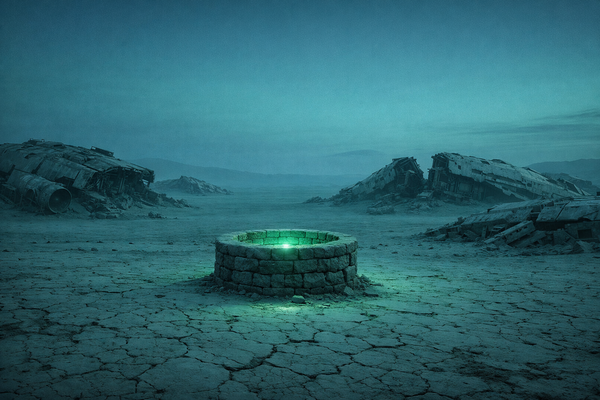
The dead franchises are burnt-out stars. The failed attempts are brown dwarfs. And the well, the vast reservoir of unadapted science fiction literature, is the Pillars of Creation. Stellar nurseries where new stars are actively forming, if the conditions allow it.
That was the argument before. This is the argument now:
The well is not just untapped potential. It is the only source of what comes next.
Every franchise that exists today was once new. Star Trek was new. Star Wars was new. Marvel, before the MCU, was a comic book company that had gone bankrupt. These became institutions because someone took a risk on something unfamiliar and then had the patience to let it find its audience.
That path is now closed. Not because the ideas aren't there. The well is deep and full. But the system we built cannot afford the time, cannot absorb the uncertainty, cannot tolerate the slow accumulation that turns an unknown property into a cultural institution.
New Stars, or None
The slow burn did not disappear because audiences stopped wanting it.
It disappeared because the system stopped allowing it.
And now, the thing it built instead, the franchise-dependent, algorithmically curated, measurement-optimized machine, is running out of fuel.
There is a franchise whose opening words are a promise to explore strange new worlds. To seek out new life and new civilizations. To boldly go where no one has gone before.
The actual strange new worlds — the stories that have truly never been told on screen — are not inside that franchise. They are sitting in the Pillars, waiting. Worlds that no audience has seen. Civilizations that no writer's room has built. Ideas that no algorithm has tested because they have never been given the chance.
The franchise recites the mission. The industry refuses to fund it.
The strange new worlds are out there. They always have been. But we keep sending ships to the same ports, and wondering why the maps never change.
You cannot reignite a dead star.
You can only give birth to new ones.
The material is there. The conditions are not.