The Rollerball Economy

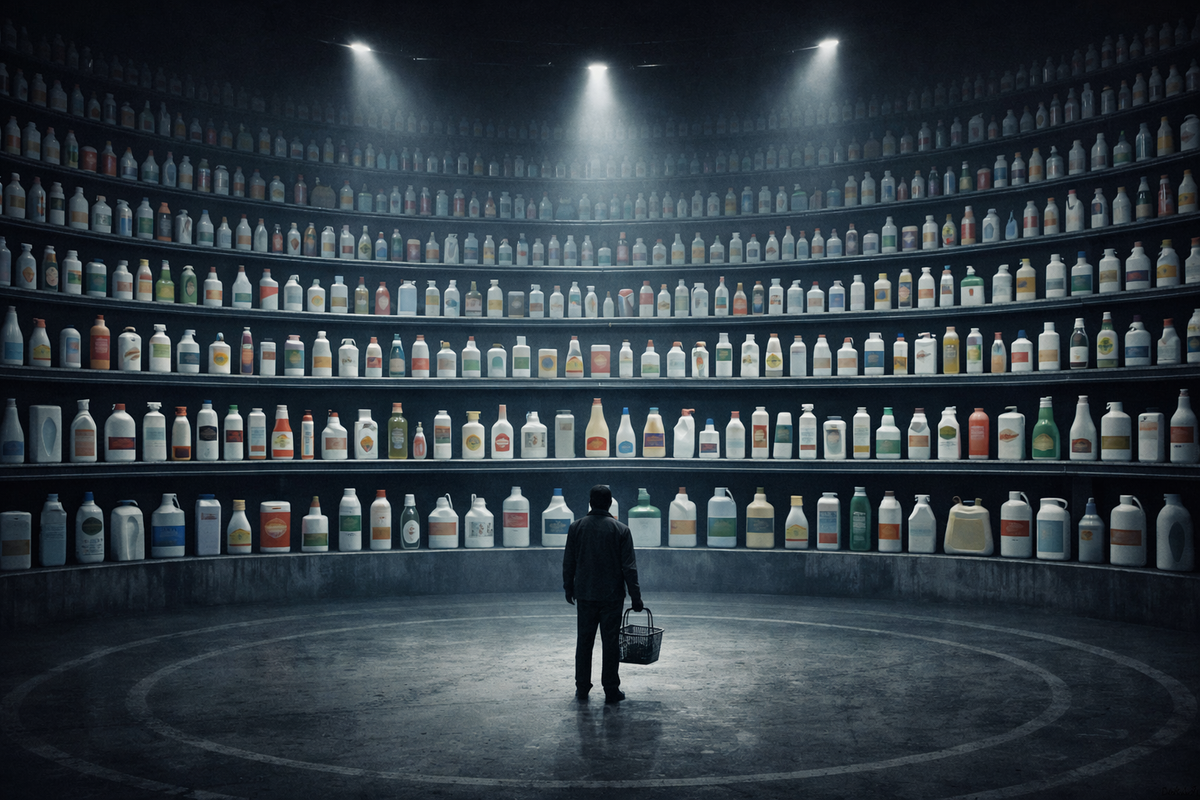
The restaurants still have different names. The shelves still have different labels. But the supply chains, payment networks, servers, and energy infrastructure beneath are converging into fewer and fewer hands. More choice. Less difference. And a system that needs you to consume but doesn't need you to choose.
Disclosure: The author is employed in the technology industry. This essay reflects personal views and interpretation of publicly available information. It represents my opinions alone, not those of any employer or organization, and is not professional, investment, or policy advice.
Everyone remembers the joke from Demolition Man.
In the future, every restaurant is Taco Bell. Total brand consolidation. One logo, one menu, one culture. It was meant to be absurd.
Fewer people remember Rollerball.
In that film, corporations didn't replace brands. They replaced nations. Energy, food, housing, transport, each sector is controlled by a single corporate entity. It wasn't a story about products. It was a story about infrastructure.
Demolition Man imagined a future where everything looks the same. Rollerball imagined one where it doesn't matter what anything looks like, because the same handful of entities control how everything moves.
We're building the second one.
Not overnight. Not through some dramatic, hostile takeover that makes the evening news. It's quieter than that, and more consequential.
The consolidation of the supply chain.
Sysco's move on Restaurant Depot is one example, but it's a revealing one. Restaurant Depot was where independent operators went to buy outside the Sysco ecosystem. The diners, the taco trucks, the family-run Italian places. It was the alternative. When Sysco absorbs that alternative, it doesn't put those restaurants out of business. It pulls them into the same pipeline as everyone else.
That's where the Demolition Man prediction comes true, just not the way the movie imagined.
You don't get one restaurant. You get thousands of restaurants with different names, different menus, and different cuisines. But increasingly, the same inputs. French fries from the same processors. Beef from the same packers. Bread from the same industrial bakeries. Cheese, pasta, cooking oils, and sauces all converge onto the same trucks from the same distributors.
When inputs converge, outcomes follow.
A burger at one place starts to taste like a burger somewhere else. Pizza follows the same trajectory. Even cuisines that are supposed to be distinct, Thai, Peruvian, and Ethiopian, begin to flatten at the edges because they're drawing from the same commodity base. The spice blends might differ, but the proteins, the starches, the fats are all coming through the same door.
This isn't about chefs losing skill or restaurants cutting corners. It's economics. Margins are razor-thin. Labor is expensive. So operators optimize for consistency, availability, and cost. That optimization pulls them toward the same supply chains, because those are the only ones with the scale to deliver what they need at a price they can absorb.
In South Florida, this effect is amplified. We don't produce much of what we consume at scale. The agricultural corridor in Homestead puts out tomatoes, peppers, and avocados, but the vast majority of what feeds Broward and Palm Beach comes through distribution. When distribution consolidates, the small differences that once arose from geography and local sourcing erode. Not because anyone chose to erase them, but because the system no longer supports them.
That's the loss people feel without being able to name.
When someone says the pizza down here doesn't taste like New York, they're not making a supply chain argument. But that's what it is. The water myth is a coping mechanism. The real difference was always flour sourcing, tomato suppliers, cheese distributors, and dough practices passed through generations of bakers buying from the same local mills. When those inputs converge onto the same Sysco truck, the pizza doesn't become bad. It becomes generic. And generic is what people taste when they say something is missing, but can't identify what.
Food is where you feel this first, because food is sensory. You can taste consolidation. You can't taste it in your pharmacy.
And that's exactly why nobody noticed when it happened there.
Twenty years ago, Americans filled prescriptions at independent pharmacies, regional chains, and grocery store counters. Now CVS and Walgreens control roughly half of all prescription volume in the United States. CVS didn't stop there. It absorbed Aetna, built MinuteClinic, and vertically integrated from insurance to diagnosis to dispensing. Your pharmacist may still know your name. But the infrastructure behind them was consolidated completely, and nobody mourned it because the pharmacy is transactional. You want your pills, you want your copay processed, you want to leave. Nobody writes essays about the loss of regional prescription culture.
You can see what this looks like at the shelf level. Walk into a CVS this weekend to buy cough syrup and count the options. Twenty bottles, maybe more, spread across multiple brands and store labels. Read the back of each one. They are functionally the same product. Dextromethorphan, acetaminophen, and either an antihistamine or an expectorant, in nearly identical doses. Different bottles. Different prices. Different packaging is designed to suggest meaningfully different products. But the formulation is the formulation.
Faced with this, you do the only rational thing. You buy the cheapest one.
That's not savvy shopping. That's resignation. Once you see it in cough syrup, you start seeing it everywhere. Paper towels, batteries, cleaning supplies, pain relievers. The number of actual manufacturers behind the apparent variety is a fraction of what the shelf suggests. Not outrage. Not protest. A shrug. Buy the cheapest version of the same thing and move on.
The pattern repeats everywhere you look, once you start looking.
Amazon has replaced the retail layer for a growing share of American commerce. Not every store. Not yet. But enough that it now functions as the default. The thing you check first. It's not a store. It's the system stores run on.
Walmart is doing the same thing in physical space, and its target isn't the mall. It's the supermarket. In less-populated areas, Walmart is steadily displacing regional grocery chains, becoming the primary source of food for communities that once had options. Costco operates as the volume layer, with Sam's Club in a secondary position. Between them, they're reshaping how Americans buy in bulk, what products are available at scale, and which suppliers survive.
The traditional supermarket layer is hollowing out between them. Whole Foods is Amazon. Aldi acquired Southeastern Grocers, converted 220 Winn-Dixie and Harveys locations to its own format, and sold the remaining 170 to a wholesale consortium. The Winn-Dixie name survives, but the ownership and supply infrastructure behind it has been reshuffled completely. Kroger is closing 60 stores over 18 months. Albertsons is shuttering dozens after its failed mega-merger with Kroger. Amazon killed off its Fresh grocery stores to double down on Whole Foods. Publix keeps expanding, and a handful of strong regional players like H-E-B and Trader Joe's hold their ground. But count the names that are actually independent, and the number gets small fast. The failed Kroger-Albertsons merger didn't stop consolidation. It redirected it into dozens of quieter deals. Fewer decision-makers controlling more of the shelf.
Logistics has consolidated in parallel. FedEx and UPS built the legacy networks. Amazon is building a parallel system that may eventually be offered as infrastructure to everyone. The railroad of the 21st century is owned by the company that also owns the freight.
The digital layer is already done. AWS, Microsoft Azure, and Google Cloud run the servers behind nearly everything. The restaurant's ordering system, the pharmacy's prescription database, the delivery app tracking your food, the payment terminal at the register. Three companies control the computational substrate of modern commerce. This consolidation is invisible because it has no consumer-facing brand. You never see it. You just depend on it.
And then there's the toll booth.
Every transaction in nearly every one of these systems, regardless of brand, sector, or geography, flows through one of two companies. Visa or Mastercard. American Express operates its own network, but it functions as a premium lane for higher-income consumers and business travelers, not mass-market infrastructure. The foundational payment layer consolidated years ago, and nobody talks about it, because the card in your wallet still has your bank's name on it.
Except that the card itself is disappearing. More and more transactions happen through a phone. Apple Pay, Google Pay, tap-and-go. Another consolidation layer was added on top of the existing one. You tap your phone. Apple takes a cut. The transaction flows through Visa or Mastercard underneath. Your bank's name appears on the screen, but it's a label on a pipeline it doesn't control. Three layers stacked on top of each other: the network, the device, and the bank, reduced to a brand, and most people experience it as convenience.
There's one more sector where this consolidation is about to accelerate, and the current geopolitical crisis is the accelerant.
The war in Iran and the closure of the Strait of Hormuz have pushed petroleum past $100 a barrel. Gas prices are approaching $4 a gallon domestically. Analysts warn that if the strait isn't reopened by mid-April, the situation gets dramatically worse as strategic reserves run dry. Energy shocks reward scale and punish independence. The operators who survive are the ones with the deepest supply chain relationships. Everyone else either joins the pipeline or closes.
The pressure is most acute for commercial transport. Diesel has surged past $5 a gallon nationally, and above $6 a gallon in California. At the beginning of March, it was under $4. Fuel accounts for roughly a fifth of total cost per mile in trucking, and those costs spread into everything that moves by truck: groceries, building materials, household goods, and the restaurant supplies arriving on those Sysco trucks we were just talking about. Higher diesel makes everything else in this essay more expensive.
Sustained diesel at this level changes the calculus on electrification. When $5 diesel persists for months, the payback period on electric trucks and freight infrastructure shortens dramatically. The companies with the capital to switch first will control the next generation of freight movement. That pressure extends to EV charging broadly. Right now, the landscape looks like early-stage competition: Tesla's Supercharger network, ChargePoint, Electrify America, a handful of others. But the capital requirements are enormous. If sustained petroleum prices push EV adoption faster than planned, charging infrastructure will consolidate rapidly. The question is whether it follows the gas station model, fragmented and branded differently, or the telecom model, where three carriers control access, and everyone picks one. Given the economics, bet on telecom.
But electrification doesn't reduce energy demand. It moves it. You're transferring the petroleum problem from the tailpipe to the power plant. And the power plant isn't ready.
The grid was built for a world where demand was flat and predictable. That world is over. EVs add load at the consumer level. Commercial fleet electrification adds it at the industrial level. AI data centers are consuming electricity at a scale the grid was never designed to support. US data center power demand is projected to nearly triple by 2030, reaching 134 gigawatts, with a projected 49-gigawatt generation shortfall by 2028.
To put that in perspective: the entire US nuclear fleet, 94 reactors built mostly between 1967 and 1990, generates about 97 gigawatts. Data center demand alone will, by 2030, exceed the output of every nuclear power plant in the country. That's before you add a single EV charger or electric freight truck to the grid. Total US generating capacity is roughly 1,200 gigawatts. Data centers will consume more than 10% of it, and they largely need to be located in the US for sovereignty, latency, and security reasons. This isn't a load you can offshore.
Solar and wind can't close that gap alone. Renewables are growing fast, 86 gigawatts of new capacity in 2026, more than half solar. But the sun sets. The wind stops. Data centers don't shut down at dusk. EV networks don't go idle when the wind dies. Commercial fleets don't park their trucks because it's cloudy. These are constant, around-the-clock demands.
You hear the claim that an area the size of Rhode Island covered in solar panels could power the country. The generation math may be roughly correct. What nobody talks about is what happens when those panels go dark. The US consumes roughly 12 terawatt-hours of electricity per day. Solar generates during about six peak hours. Storing enough to cover the other eighteen hours would require roughly 56 times the total battery capacity the United States has installed over the past five years. Add a three-day buffer for weather events, which is the bare minimum for grid reliability, and that number climbs past 150 times. Picture every utility-scale battery installation in America. Now multiply it by 150. That's what "just build batteries" actually means.
Grid-scale batteries don't solve this. Current systems provide four to eight hours of storage. The scale required to backstop a solar-powered grid isn't an engineering challenge awaiting a budget. It's a materials constraint. The lithium, cobalt, and nickel required to manufacture batteries at that scale would consume decades of current global mining output, which means creating a new ecological crisis to address the energy crisis. The extraction of these minerals is already devastating landscapes and water tables in South America, Central Africa, and Southeast Asia. Scaling it by orders of magnitude doesn't solve a resource problem. It relocates it.
And none of this is static. Grid-scale batteries degrade and need replacement every 10 to 15 years. Solar panels lose efficiency over time and have usable lifespans of 25 to 30 years, after which they become electronic waste at a scale we have no infrastructure to recycle. A solar-and-battery grid isn't something you build once. It's something you rebuild continuously, each cycle requiring another round of mining, manufacturing, shipping, and disposal. The maintenance tail alone is a permanent industrial commitment. Barring a quantum leap in energy density that no one in materials science is predicting, batteries won't close the gap. Fusion and hydrogen breakthroughs are more likely to arrive first.
The technology that can provide baseload power at scale without carbon emissions is nuclear. Modern designs are significantly safer than those built in the 1960s and 1970s. The current US fleet operates at a 92% capacity factor. This is not the technology that people protested at Three Mile Island. But public perception has not kept pace with the engineering. Executive orders signed in 2025 set a target of quadrupling US nuclear capacity from roughly 100 gigawatts to 400 by 2050, with 10 new large reactors under construction by 2030.
Here's the problem. We spent decades making this nearly impossible. Forty years of protest, litigation, and regulatory layering turned nuclear construction into a process that takes 15 to 20 years from proposal to operation, when it happens at all. The last reactors to come online before Vogtle's recent additions were completed in the 1990s. We built an institutional apparatus designed to prevent the addition of new nuclear capacity. Now we're being asked to dismantle it overnight, because the demand curve doesn't care how long it took to build the barriers. The electricity is needed now. The reactors are not.
Two paths forward. The first is education: transparent, sustained public engagement about what modern nuclear actually is and why the math requires it. Long, expensive, politically difficult. It is the democratic path, and it is worth doing. The second is authoritarian implementation: executive action, regulatory override, expedited permitting that bypasses community input. Faster. Also, the kind of approach that erodes public trust and generates the next generation of opposition.
Other countries won't wait for us to decide. China has 57 operating reactors and 29 under construction on five-year timelines. South Korea, France, India, and the UAE are all expanding with regulatory frameworks that move faster than ours. If the US can't resolve its contradictions over nuclear power, the energy infrastructure that supports the next generation of industry will be built elsewhere. And whoever builds it will control it.
Nuclear solves for electricity. But aviation can't electrify at scale. Rockets don't run on batteries. Long-haul ocean freight isn't going electric. And diesel will remain critical to commercial transport for decades during the transition. The war in Iran demonstrated what happens when the liquid fuel supply chain passes through a single chokepoint. We need a domestic source of diesel, aviation fuel, and industrial feedstocks that doesn't depend on the Strait of Hormuz staying open.
That source exists. Industrial hemp can produce biodiesel with a 97% conversion rate from seed oil, outperforming soy and canola on combustion quality and cold-weather performance. But hemp isn't just a fuel crop. It's a platform crop. The same plant produces fiber for textiles and composites, protein from the seed, cooking oils, bioplastics, and yes, cannabinoids. A massively scaled hemp industry wouldn't just address the vulnerability to liquid fuel. It would create a parallel domestic supply chain for materials that currently depend on petroleum-derived inputs.
I wrote about this in 2022, when the Russia-Ukraine war was the energy crisis of the moment. The argument was the same: nuclear for electricity, hemp for liquid fuels and industrial feedstocks, because the United States cannot remain strategically dependent on petroleum that ships through contested waterways. Four years later, a different war has closed a different chokepoint, and we've done none of it. The structural exposure hasn't changed. The crisis is proving it has.
The transmission and distribution infrastructure that moves electricity from source to consumer is decades old and was never built for loads of this magnitude. Upgrading it is a multi-trillion-dollar project. Whoever builds, owns, and operates that infrastructure will control the energy layer of the economy, just as Sysco controls food and Visa controls payments.
Energy is the final consolidation. Everything else depends on it.
Amazon owns the digital storefront. Walmart and Costco own the physical one. Sysco owns the restaurant and institutional pipeline. CVS and UnitedHealth own the pharmacy-to-insurance vertical. Three cloud providers own the servers. Two payment networks process the transactions while Apple and Google own the devices you use to make them. A small number of companies will own the charging and freight infrastructure that replaces petroleum. And behind all of it, the electrical grid itself will need to be rebuilt at a scale that only a handful of entities can finance.
That's Rollerball.
The film wasn't just about corporate control of infrastructure. It was about the elimination of the individual. The sport existed to teach people that no single person could stand up to organizational power. Jonathan E. was dangerous not because he could win, but because his individual excellence contradicted the message. The system didn't need him to lose. It needed him to stop mattering.
That's what supply chain consolidation does to consumer choice. It doesn't take away your options. It makes them irrelevant. You still get to pick. But the picking no longer changes anything, because the options have converged underneath. The individual's ability to make a choice that matters, to support a different supplier, to taste a different product, to opt out of the pipeline, shrinks with every merger, every acquisition, every distribution contract that pulls another independent operator into the same system. You can choose between forty hot sauces at the grocery store. But three companies made them, two trucks delivered them, you paid by tapping a phone that took its cut before routing the transaction through one of two payment networks, and the servers that tracked the inventory belong to one of three cloud providers.
More choice. Less difference.
The movie imagined a world where every restaurant had the same name.
We're building one where they don't.
They just increasingly taste the same.
We saw all of this coming. That's the part that's hard to sit with.
Demolition Man warned us about cultural monoculture. Rollerball warned us about corporate infrastructure replacing public systems. Soylent Green warned us about what happens when the population outgrows resources. We watched these films, absorbed their warnings, and treated them as entertainment. What we did not count on was getting all of them. Not one dystopia, clean and recognizable, but pieces of each, layered on top of one another, arriving not with a dramatic reveal but through quarterly earnings reports, distribution contracts, and energy policy no one reads.
The hardest truth is that there may not have been a better path. A planet with a growing population and finite resources was always going to consolidate how it moves goods, generates power, and feeds people. Efficiency demands scale. Scale demands consolidation. Consolidation demands fewer decision-makers. Four years ago, I wrote about solving scarcity. This essay is about accepting that solving it comes with costs: human costs, cultural costs, the slow erosion of individual agency in a system that needs you to consume but doesn't need you to choose.
The solution and the loss are the same thing.