53 Years

Disclosure: This reflects my personal experience and interpretation of publicly available information. It represents my views alone—not any employer or organization—and is not professional advice.,
Fifty-three years. That's how long it took us to go back to the Moon.
Apollo 17 returned in December 1972. Artemis II splashed down on April 10, 2026, in the Pacific off San Diego. Four astronauts. Ten days. 695,000 miles. The farthest any human has ever traveled from Earth.
We celebrate the achievement. We should. But there is a question underneath the celebration that nobody seems to want to ask out loud: why did it take so long?
The standard answer is funding. Political will. We chose differently. We pivoted to the Shuttle, then to the ISS, and then argued for two decades about what comes next. This is the story everyone tells. It's not wrong. It's incomplete.
The real answer is structural. The institutions that put humans on the Moon were systematically dismantled, merged, hollowed out, redirected, and starved over five decades. Not by malice. By fragmentation. The same fragmentation that gave us the personal computer, the internet, the iPhone, and the modern technology industry also destroyed our capacity to coordinate at a planetary scale.
The obvious objection: Apollo-era spending was unsustainable. It consumed 4.41% of the federal budget at its 1966 peak. That was a Cold War anomaly. But spending didn't need to stay at 4%. It was already down to 2.3% the year we landed on the Moon, and 1.6% when Apollo ended. It kept falling: to under 1% by 1976, to 0.75% by 1986, and to 0.35% by 2025. NASA's current annual budget is roughly $25 billion. At a quarter of the Apollo peak, it would be double that. We didn't choose a sustainable reduction. We chose near-elimination.
And we abandoned the most productive technology transfer engine the country ever had. Apollo didn't just produce spacecraft. It produced materials science, semiconductor innovation, software engineering, and manufacturing techniques that seeded entire industries. We didn't just cut a line item. We shut down the factory that was producing the future.
I wrote about this from the other direction recently. An essay about the computing industry that For All Mankind never needed to build. What if IBM never fell? What if the space race never ended? That essay is a thought experiment. This one is an autopsy.
The show is a useful lens, but you don't need it to see what happened. In our timeline, the Soviet N-1 rocket failed, and they never reached the Moon. The space race ended because we won. And then we made a choice. We ended Apollo in 1972. That was a deliberate decision, not an inevitability, and this essay argues it was a mistake.
The Companies That Built Saturn V
Years ago, I wrote a series for ZDNet called "To the Moon," documenting the companies behind Apollo 11. The first essay in this pair used IBM and UNIVAC, the system integrators. This one uses the other half: the companies that built the hardware that left the ground.
Boeing built the S-IC first stage, the most powerful rocket stage ever flown. Five F-1 engines producing 7.5 million pounds of thrust. Built at the Michoud Assembly Facility in New Orleans, tested at what is now Stennis Space Center in Mississippi. When all five engines fired together, they shattered the plate-glass windows of a bank fifteen miles away.
Rocketdyne built the F-1 and J-2 engines that powered the upper stages. Every pound of thrust that got Apollo off the ground came from Rocketdyne hardware. The F-1 remains the most powerful single-chamber rocket engine ever flown.
North American Aviation built the S-II second stage and the Command and Service Module. The capsule that kept three astronauts alive for eight days in a space smaller than the inside of a minivan.
Douglas Aircraft built the S-IVB third stage, the one that performed the trans-lunar injection burn. The last push. The moment you stop orbiting the Earth and start heading for the Moon.
Grumman built the Lunar Module. The machine that actually landed on the Moon. Built on Long Island by engineers who commuted from the same suburbs where their kids played Little League.
Five companies. Five major components. One coordinated system. It worked because the pieces fit together, because the institutions were intact, and because there was a single, sustained purpose driving it all.
Every one of those companies is gone. Some of the names survive, absorbed into conglomerates. The companies themselves, the engineering cultures, the institutional knowledge, are gone.
The Distraction
I wrote about why the Space Shuttle had to be put out to pasture years ago. The argument has only gotten stronger with time.
The Space Shuttle was approved in 1972. The same year Apollo ended. Think about that timing. The most ambitious exploration program in human history ends, and its replacement is approved in the same breath. Except the replacement doesn't go anywhere.
The Shuttle was sold as the vehicle that would make space access routine and affordable. Fifty flights a year. A hundred dollars a pound to orbit. The pickup truck of space. Instead: 135 missions over 30 years. Roughly $27,000 per pound to orbit. Fourteen astronauts dead in two disasters. And it never left low Earth orbit. Not once.
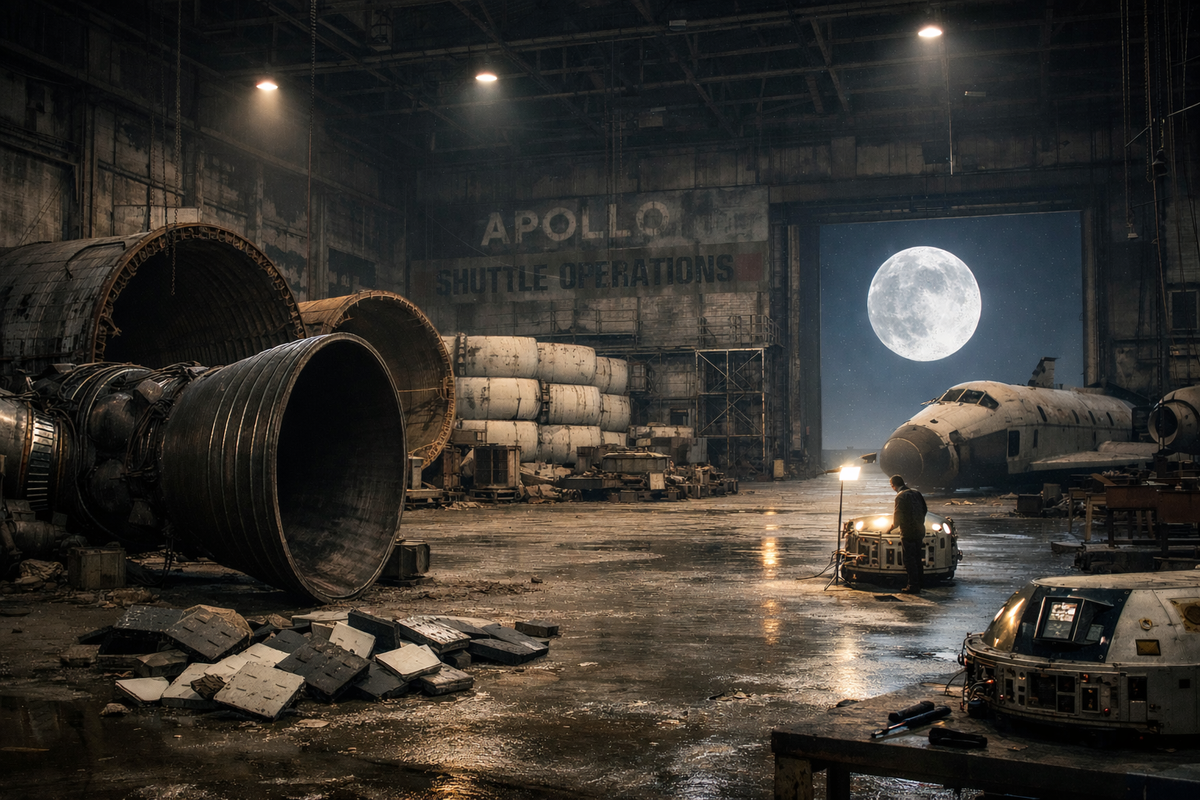
And to build it, we threw away everything that worked. The Saturn V production line at Michoud was shut down. The F-1 engine, the most powerful single-chamber rocket engine ever flown, was abandoned. The J-2 upper stage engines, proven and reliable, were shelved. Tested platforms. Reliable platforms. Platforms we could have iterated on for decades.
Instead, we started over from scratch with solid rocket boosters, a new main engine that required rebuilding after every flight, and a thermal protection system that proved fatally fragile. The Shuttle didn't build on Apollo. It replaced Apollo with something less capable, more expensive, and more dangerous. Every dollar and many of the best engineers that went into developing SRBs and SSMEs were dollars and people not spent extending the hardware that had already proven itself.
The SSME and solid rockets have technical advantages in specific applications, but the fact that NASA later developed the J-2X, an updated version of the very engine it had abandoned, tells you everything about the cost of starting over.
For three decades, the most powerful space agency on earth spent its budget, its talent, and its institutional attention going in circles 250 miles above the surface. The Moon was right there. Mars was theoretically reachable. And we were building a truck that only drove around the block.
The Shuttle consumed everything. It consumed the budget that could have funded a return to the Moon in the 1980s. It consumed the engineering talent that could have designed deep-space vehicles. It consumed the political oxygen: as long as the Shuttle was flying, Congress could point to it and say we had a space program. We didn't. We had a low-Earth-orbit delivery service with a catastrophic failure rate.
And when it killed seven astronauts on Challenger in 1986 and seven more on Columbia in 2003, the investigations didn't just find O-ring failures and foam insulation problems. They found an institution that had normalized risk, deprioritized safety, and lost the engineering discipline that characterized Apollo. The same cultural failures, seventeen years apart. The culture had degraded along with the mission.
The Shuttle is the chapter of this story that makes people uncomfortable. Because it wasn't imposed on us. We chose it. We chose it over the Moon. Over Mars. Over everything Apollo made possible. And we chose it for the same reason we fragment everything: because it seemed practical, incremental, and achievable. The pickup truck instead of the starship. The PC instead of the mainframe.
This is not an argument that nothing was accomplished. The robotic missions alone justify pride. Voyager reached interstellar space. Cassini spent thirteen years at Saturn. The Mars rovers, from Sojourner to Perseverance, conducted geologic research on another planet. OSIRIS-REx landed on an asteroid and returned samples to Earth. Rosetta put a lander on a comet. The James Webb Space Telescope is rewriting our understanding of the early universe. Hubble, deployed by the Shuttle, transformed astronomy. The ISS produced real science in microgravity for over two decades.
These are genuine achievements, and the people who made them happen deserve more recognition than they get. The teams keeping Voyager alive decades past its design life, coaxing data from a spacecraft running on 1970s hardware with the power output of a refrigerator light bulb, are doing some of the most resourceful engineering in history.
But that resourcefulness is itself the tell. These missions were accomplished in an environment of scarcity, not abundance. Everyone was fighting within a budget-constrained, delayed, and descoped NASA. They succeeded because brilliant people did extraordinary work with less than they needed. We got one instead of both.
And the consequences extend beyond science. When the Shuttle retired in 2011, the United States had no way to send astronauts to space. For nine years, America bought seats on Russian Soyuz rockets. The country that built Saturn V was paying its Cold War rival for rides to a space station it helped build.
We flew national security payloads on Atlas V rockets powered by Russian RD-180 engines. The RD-180 is a remarkable engine — its closed-cycle design offered real advantages. But there's a difference between learning from another country's engineering and depending on it because you threw away your own.
The communities that built Saturn V components were hollowed out by the same contraction. Manufacturing towns, engineering centers, skilled labor forces — decades of economic decline rooted in industrial abandonment. Some of the political anger that defines the current moment traces back to exactly this. That's not a partisan observation. It's a structural one.
But it is also only one thread. Ending Apollo set off a butterfly effect that no alternate history experiment can fully account for. The point is not that we can predict what would have happened. The point is that the decision to stop had costs that compounded for decades in directions nobody anticipated, and we are still paying them.
The Merger Chain
While the Shuttle was consuming NASA's attention, something quieter was happening to the companies that built Saturn V. They were eating each other.
North American Aviation merged with Rockwell in 1967 to form North American Rockwell, later Rockwell International. Boeing acquired Rockwell's aerospace and defense divisions in 1996.
Douglas Aircraft merged with McDonnell to form McDonnell Douglas in 1967. Boeing acquired McDonnell Douglas in 1997.
In two years, Boeing absorbed the companies that built the first stage, second stage, third stage, and Command Module of Saturn V. Three of the five primary Apollo contractors were folded into a single entity.
Grumman, the company that built the Lunar Module, merged with Northrop in 1994 to form Northrop Grumman.
Rocketdyne, the company that built every engine that powered the Saturn V, bounced among Rockwell, Boeing, Pratt & Whitney, and Aerojet, and now sits within L3Harris. Five owners in three decades for a company whose entire value proposition is knowing how to make rocket engines not explode.
This is the HP-Compaq-DEC chain applied to the aerospace industry. Each merger is justified by efficiency, synergy, and cost reduction. Each merger destroys engineering culture, institutional memory, and the specific knowledge of how to build things that work. The acquiring company gets the contracts and the intellectual property. It loses the people and the judgment.
You don't acquire your way to the Moon. You acquire your way to cost overruns, schedule delays, and spacecraft that can't dock with the space station.
The Brain Drain Nobody Talks About
While the Shuttle was circling and Boeing was absorbing the carcasses of Apollo's contractors, something else was happening. A growing share of the best engineers in the country stopped going to aerospace.
In the 1960s, NASA was the destination. The smartest people in the country wanted to work on the space program. The pay was government scale, but the mission was irresistible. You were putting humans on the Moon. Nothing else competed with that.
Then the space program contracted. And at the same time, Silicon Valley emerged. The personal computer created an entirely new industry with an insatiable demand for engineering talent and compensation that aerospace couldn't match. The talent pipeline that fed Apollo redirected toward consumer technology.
The next generation's best and brightest went to Intel, Microsoft, Apple, and eventually Google and Facebook. Not because they didn't care about space. Because the economic structure pointed them somewhere else.
NASA went from being the place where the best people in the country wanted to work to being the place they left. The brain drain wasn't sudden. It was generational. Each cohort of engineers that retired from the Apollo-era companies was replaced by a thinner, less experienced cohort. The institutional knowledge that made Apollo work didn't disappear in a single event. It evaporated over decades.
The computing revolution that I documented in the first essay didn't just create new companies and new careers. It actively degraded aerospace's ability to function by competing for the same finite pool of engineering talent and winning.
And it wasn't just the people. The tools splintered, too. Apollo ran on integrated IBM and UNIVAC systems designed as a whole. Artemis runs on commercial off-the-shelf software from dozens of vendors stitched across multiple platforms. Integration went from being the assumption to being the problem. Every interface between systems is a place where institutional knowledge leaks out and never comes back.
None of these forces would have been fatal alone. Together, they were devastating. The Shuttle consumed the budget, the mergers destroyed the engineering cultures, the brain drain emptied the talent pipeline, and the tools splintered beneath everyone's feet. Each force reinforced the others.
The Shuttle justified the mergers because there wasn't enough work for independent contractors. The mergers accelerated the brain drain because acquired engineers left. The brain drain degraded the tools because nobody remained who understood the integrated systems. By the time anyone noticed the compound effect, the institutional capacity that put humans on the Moon was gone.
We didn't lose the Moon because we forgot how to build rockets. We lost it because we forgot how to build institutions.
Boeing Today
Boeing builds the SLS core stage for Artemis. The same company. The same factory in New Orleans where the S-IC first stage was built for Saturn V. Boeing's marketing materials lean heavily on that continuity. "Boeing-built products helped land humankind on the Moon in 1969, and we're proud to continue that legacy."
The legacy they don't mention: SLS has been in development since 2011. It is years behind schedule and billions over budget. The company that contains the DNA of three Apollo prime contractors took over a decade to build a rocket that, by most measures, is less capable per dollar than what a startup in Hawthorne, California, builds in a fraction of the time.
And then there's Starliner. Boeing's crew capsule, contracted alongside SpaceX's Dragon under the same NASA program. Dragon has been flying astronauts to the ISS since 2020. Starliner flew its first crewed test in 2024, docked with the station, and then couldn't bring its crew home. The astronauts had to wait for SpaceX to rescue them. The company that absorbed North American Aviation, the company that built the Apollo Command Module, could not build a spacecraft that reliably returned astronauts from low Earth orbit.
This is not a funding problem. Boeing has received billions. This is a structural problem. The engineering culture that built Saturn V has been merged, acquired, reorganized, and optimized out of existence. The contracting model compounds it: cost-plus contracts incentivize spending over results. Boeing gets paid more when programs take longer. SpaceX operates on fixed-price contracts that incentivize delivery.
People point to NASA and the aerospace primes as proof that government space programs are inherently wasteful. But that waste is a symptom, not a cause. Apollo put men on the Moon in eight years for roughly $300 billion in today's dollars. The waste came after, when the purpose left and the structure collapsed. The contracts remain. The capability doesn't.
And here's the final indignity: when astronauts finally land on the Moon again on Artemis IV, they'll get there on a Boeing SLS rocket but land in a SpaceX Starship or a Blue Origin Moon lander. The company whose DNA was Apollo's prime contractors is building the ride to orbit. The startups are building the machines that actually touch the Moon. Boeing gets the legacy. SpaceX and Blue Origin get the surface.
SpaceX Is Linux
SpaceX exists because the institutions failed.
Elon Musk didn't start SpaceX because he thought aerospace was a good business opportunity. He started it because he tried to buy a rocket from the Russians, couldn't, and concluded that the existing aerospace industry was too broken to achieve his goal of reaching Mars. So he built a rocket company from scratch.
SpaceX reconstituted vertical integration from the ground up. It designs its own engines. It builds its own rockets. It manufactures its own spacecraft. It launches, lands, and reuses its own hardware. It controls the stack. This is not how modern aerospace works. Modern aerospace is a web of prime contractors, subcontractors, sub-subcontractors, and cost-plus contracts that incentivize spending over results.
To be clear: SpaceX didn't conjure capability from nothing. It used NASA facilities, NASA contracts, NASA funding, and decades of institutional rocket science. The Merlin engine has roots in NASA research. But SpaceX recombined that institutional knowledge with startup discipline, fixed-price accountability, and a willingness to fail fast that the legacy contractors had been optimized out of. The ingredients were there. The recipe was new.
SpaceX is the Linux of aerospace. Linux exists because Linus Torvalds concluded that existing institutional Unix was too controlled and too expensive, so he rebuilt it from scratch. SpaceX exists because Musk concluded that existing institutional aerospace was too consolidated and too broken, so he rebuilt it from scratch. Both are responses to the same structural problem: institutions hollowed out by the same merger-and-consolidation cycle, until it was faster to start over than to fix what was there.
And the parallel isn't just structural. It's literal. SpaceX's Falcon 9 and Dragon spacecraft run Linux on their flight computers. The software born from the collapse of institutional Unix is now literally flying the missions that IBM System/360s were originally built to support.
Apollo ran on custom IBM hardware. SpaceX runs on open source software and commodity processors. The institutional model, rebuilt on the tools the fragmentation produced.
That's the synthesis. SpaceX doesn't return to the For All Mankind model. It combines the structural discipline of the old institutions — vertical integration, control the stack, own the mission — with the best products of the new ones: Linux, open-source tools, commodity hardware, and a development culture that would be unrecognizable to the engineers at Grumman and North American Aviation. Same structure. Different foundation.
The fact that a startup founded in 2002 can outperform a company that contains the combined heritage of Boeing, North American Aviation, Rockwell, McDonnell Douglas, and Hughes is the single most damning indictment of what consolidation did to American aerospace. But the fact that it does so running Linux is the most hopeful thing in this entire essay. The collapse broke the old institutions. But it also built the tools that made new ones possible.
Was it worth it? We got the personal computer, the internet, open source, the smartphone, and the most powerful information infrastructure in human history. We also lost the Moon for fifty-three years, hollowed out the companies that built Apollo, and spent three decades on a Shuttle that went nowhere. We built extraordinary things in the chaos. We also lost the ability to do the coordinated thing that mattered most.
The counterargument is obvious: a monolithic computing industry controlled by a few players would have stifled the innovation that disruption produced. Maybe. But we will never know what innovations might have arisen faster without the distraction of rebuilding the infrastructure those regulatory decisions dismantled.
Would we have reached large language models earlier in a world where Bell Labs stayed unified? Would we have avoided the social media ecosystem now tearing at the fabric of public discourse? We don't know. Would there have been downsides to that world? Almost certainly. Would there have been stability? Also probably.
The honest answer is that nobody knows, because we never got to see what the other path actually looked like.
Except on television.
The For All Mankind Parallel
In the For All Mankind timeline, none of this happens.
The space race never ends. Apollo doesn't stop. The Shuttle, as we know it, was never built because there's no gap to fill. The contractors who built Saturn V keep building because the mission keeps running. Boeing never needs to acquire North American Rockwell or McDonnell Douglas because those companies are healthy and busy. The engineering cultures survive because the work never stops.
The brain drain never happens because the space program remains the most prestigious engineering challenge in the country. The best people keep going to aerospace because aerospace keeps doing things worth doing. Silicon Valley still exists. Fairchild and Shockley predate the divergence. But computing stays institutional, stays integrated, and doesn't compete with aerospace for the talent pipeline.
The show takes dramatic license by inventing Dev Ayesa, their Elon Musk equivalent. The son of a Kenyan immigrant aerospace engineer, Dev solves the problem of nuclear fusion, founds Helios Aerospace, and enters the Mars race as a third competitor alongside NASA and the Soviets. He's charismatic, brilliant, and ruthless. He makes great television. But he's structurally unnecessary. In that timeline, Dev is an accelerant. The space program is already going to Mars. He just adds competition.
In our timeline, Musk isn't an accelerant. He's a replacement. SpaceX exists because NASA and Boeing can't do the job anymore. We don't celebrate billionaire space visionaries. We need them. That's the difference between a healthy system and a broken one. Dev Ayesa is a character the show needs. He's not a character that timeline needs.
They got to Mars in the 1990s. Not because they're smarter. Not because they have better technology. Because they have structural coherence. Sustained purpose. Institutional continuity. The things we traded away for the PC, the internet, and the iPhone.
Don't Repeat This
Artemis can be the new Apollo or the new Shuttle. Right now, the signs are mixed.
Artemis III was supposed to land astronauts on the Moon. It has been downgraded to an Earth orbit docking test, scheduled for mid-2027. The actual landing has been pushed to Artemis IV, tentatively 2028, but likely later. The Gateway lunar station was shelved in March 2026. The Trump administration proposed canceling SLS entirely after Artemis III. Legislation saved it, for now.
Each SLS launch costs an estimated $4 billion. The landing keeps slipping. The infrastructure keeps getting descoped. The intermediate steps keep multiplying.
And in 2025, roughly one in five NASA employees left the agency, the largest single-year percentage loss in its history. NASA's workforce is now at its smallest since before Kennedy's 1961 speech to Congress. The brain drain this essay describes isn't history. It's happening again.
This isn't even the first false start since the Shuttle. The Constellation program — approved under Bush in 2004, canceled by Obama in 2010, billions spent, no flight hardware produced — is proof that no plan survives a change of administration. Meanwhile, China is executing a lunar program with the kind of sustained institutional commitment this essay keeps describing, and the current Artemis urgency is driven as much by that competition as by science.
And now there's a war. Operation Epic Fury has cost an estimated $28 to $45 billion in its first five weeks. NASA's entire annual budget is $25 billion. The supplemental funding request to Congress is $80-$100 billion.
Vietnam competed with Apollo for budget and political oxygen. Apollo lost. When national security spending and exploration spending compete, exploration loses. Every time. Nobody dies if you delay a Moon landing by another year. You just lose another year. And then another. And then fifty-three of them.
Apollo didn't end because someone decided we shouldn't go to the Moon. Apollo ended because nobody decided we should keep going. The absence of a decision is itself a decision, and it is the one we keep making.
The For All Mankind timeline works because it has something we have historically struggled to maintain: intention that outlasts a political cycle. Purpose that doesn't expire with an administration. Coordination that isn't dismantled every time Congress changes hands.
The question isn't whether we can go back to the Moon. Artemis II just proved we can. The question is whether we stay. Whether we build the infrastructure, maintain the institutions, sustain the talent pipeline, and commit to the decades-long effort that going to Mars actually requires.
SpaceX, Blue Origin, and the new commercial space ecosystem may be the answer. Not the monolithic Tokugawa structure of the For All Mankind timeline, but not our fragmented chaos either. A different kind of coordination. Public-private. Competitive but sustained. If it holds.
And that "if" matters: SpaceX's institutional model depends heavily on one person's vision and capital. Boeing was hollowed out by management changes over decades. SpaceX faces the opposite vulnerability. The Linux parallel is instructive here, too: Linux survived because it built a community and a foundation beyond Torvalds. SpaceX hasn't done that yet.
The institutional pattern of the last fifty years is clear: we build things, we fragment them, we spend decades trying to reassemble them, and then we wonder why it took so long. In computing, that cycle cost us forty years and gave us the cloud. In aerospace, it cost us fifty-three years and nearly cost us the Moon entirely.
We now know what that pattern costs. We can see the pattern. The only question is whether we're willing to do something different this time or look back from 2079 and wonder why Mars took so long.
53 Years
Fifty-three years passed between the last Apollo crew and Artemis II. In that gap, we dismantled the companies that built Saturn V, spent three decades on a Shuttle that never left low Earth orbit, redirected our best engineers to build smartphones instead of spacecraft, splintered every tool and system those engineers depended on, and then wondered why it took so long to go back.
I'm aware of the irony. My career exists because of the fragmentation. I'm a former IBMer and a former Unisys employee. That's why I have this perspective. Microsoft, where I also spent years, exists because IBM lost control of the PC platform. My current employer exists because commodity hardware created the GPU market. None of these careers or companies would exist in a world where Apollo never ended. I am, in a very literal sense, arguing against the conditions that created my own professional life.
But that's the point. We don't know what that other path would have produced. The only honest answer is that we don't know, and we never will.
And that's fine. This essay isn't an argument for regret. We shouldn't dwell on what we didn't do or what could have been. What we should do is acknowledge the mistakes, understand the structural patterns that produced them, and refuse to repeat them.
There's a quote, often misattributed to Einstein, that the definition of insanity is doing the same thing over and over and expecting different results. We fragmented the mainframe industry and spent forty years rebuilding it. We fragmented the aerospace industry and spent fifty-three years getting back to the Moon.
We are rebuilding centralized infrastructure right now for AI, space, and everything that requires coordination at scale. The question is whether we build it with the institutional discipline to sustain it, or whether we fragment it again and wonder, for the third time, why it took so long to put the pieces back together.
Four astronauts came home from the Moon this last weekend. Apollo was an ending disguised as a beginning. We celebrated, and then we stopped. Artemis doesn't have to be the same story. But only if we choose differently this time. Only if we build with intention. Only if we learn from 53 years of doing it the other way.
We took the long way around. The only thing worse than a 53-year detour is taking it twice.